
Article 120 of the old UAE Labour Law allowed for termination without notice. This has been replaced by Article 44 of the new Federal Decree-Law No. 33 of 2021. This new article lists the specific, serious misconduct cases where an employer can legally dismiss you without notice.
What to Know About Summary Dismissal?
- Check the New Law: Familiarise yourself with the 12 reasons for dismissal without notice under Article 44 (listed below).
- Understand Your Rights: Know the difference between termination with a notice period and termination without one (summary dismissal).
- Seek Help if Fired: If you believe you were terminated unfairly, you can file a complaint with the Ministry of Human Resources and Emiratisation (MOHRE).
The Big Change: From Article 120 to Article 44
Many employees and employers still refer to “Article 120,” but it’s crucial to understand this is no longer the active law. Relying on outdated information can lead to serious misunderstandings about your rights and obligations.
What was Article 120?
Article 120 of the UAE Labour Law (Federal Law No. 8 of 1980) was a well-known provision. It outlined the specific reasons an employer could dismiss an employee without giving them a notice period. These were typically for acts of gross misconduct.
Why Article 120 is no longer applicable
On 02 February 2022, a new labour law, Federal Decree-Law No. 33 of 2021, came into full effect. This new law repealed the old Federal Law No. 8 of 1980, meaning all its articles, including Article 120, are no longer valid.
Introducing Article 44: The new standard
The concept of summary dismissal (termination without notice) now falls under Article 44 of the new law. While the core idea is similar—firing an employee for serious misconduct—the list of reasons has been clarified and updated.
What is Termination Without Notice Under Article 44?
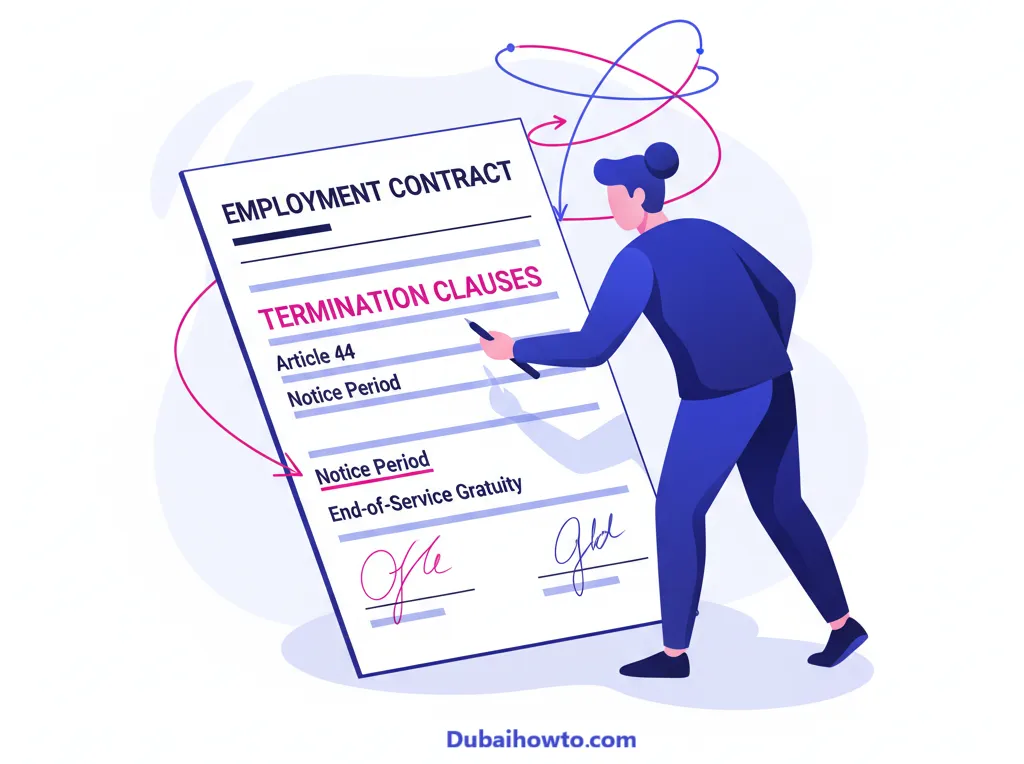
Article 44 allows an employer to dismiss an employee without any notice period, provided the employee commits one of the 12 specific violations listed in the law.
The 12 grounds for summary dismissal
An employer must be able to prove that one of these 12 incidents occurred. The dismissal must also happen within 30 days of the employer becoming aware of the incident, and after a written investigation.
Here are the 12 reasons specified in Article 44:
| Reason for Dismissal | Explanation (as per Article 44) |
| 1. False Identity | The employee submitted forged documents or used a false identity. |
| 2. Substantial Loss | The employee’s error caused a “gross material loss” to the employer, or they deliberately damaged property. The employer must report this within 7 working days of knowing. |
| 3. Safety Violations | The employee violated written safety instructions (which must be clearly displayed) and endangered the workplace or workers. |
| 4. Failure to Perform | The employee failed to perform their basic duties despite a written investigation and two written warnings of dismissal. |
| 5. Disclosing Secrets | The employee revealed a work secret related to industrial or intellectual property, resulting in loss or missed opportunity for the employer. |
| 6. Intoxication/Drugs | The employee was drunk or under the influence of illegal drugs during working hours. |
| 7. Workplace Assault | The employee assaulted the employer, manager, or a co-worker during work. |
| 8. Unexcused Absence | The employee was absent for more than 20 intermittent days in one year or more than 7 consecutive days without a valid reason. |
| 9. Abusing Position | The employee illegally used their position to obtain personal gains. |
| 10. Second Job | The employee joined another establishment without complying with the rules and procedures (e.g., without permission, if required). |
| 11. Final Legal Ruling | The employee was convicted by a final court judgment for a crime of honour, honesty, or public morals. |
| 12. Assault on Employer | The employee verbally assaulted the employer or manager (in addition to physical assault) during work. |
The burden of proof is on the employer
It is not enough for an employer to simply accuse an employee of one of these actions. They must conduct a formal, written investigation and have clear evidence to justify a summary dismissal under Article 44.
What about my end-of-service gratuity?
This is a critical update from the old law. Under the old Article 120, a summary dismissal often meant the employee forfeited their entire end-of-service gratuity.
Under the new law (Article 52), an employee does not lose their gratuity, even if terminated under Article 44. The gratuity is a statutory right calculated based on your service period.
How to Challenge an Unfair Termination?
If you are dismissed and believe it was not for a valid reason under Article 44, you may have a case for “arbitrary dismissal.”
Arbitrary dismissal vs. summary dismissal
Summary dismissal (Article 44) is a legal termination for gross misconduct.
Arbitrary dismissal (Article 47) is an illegal termination for an “illegitimate reason.” This includes being fired for filing a complaint, or for any reason not related to your work performance or conduct.
A step-by-step guide to filing a labour complaint
If you believe your termination was unfair, you must act quickly.
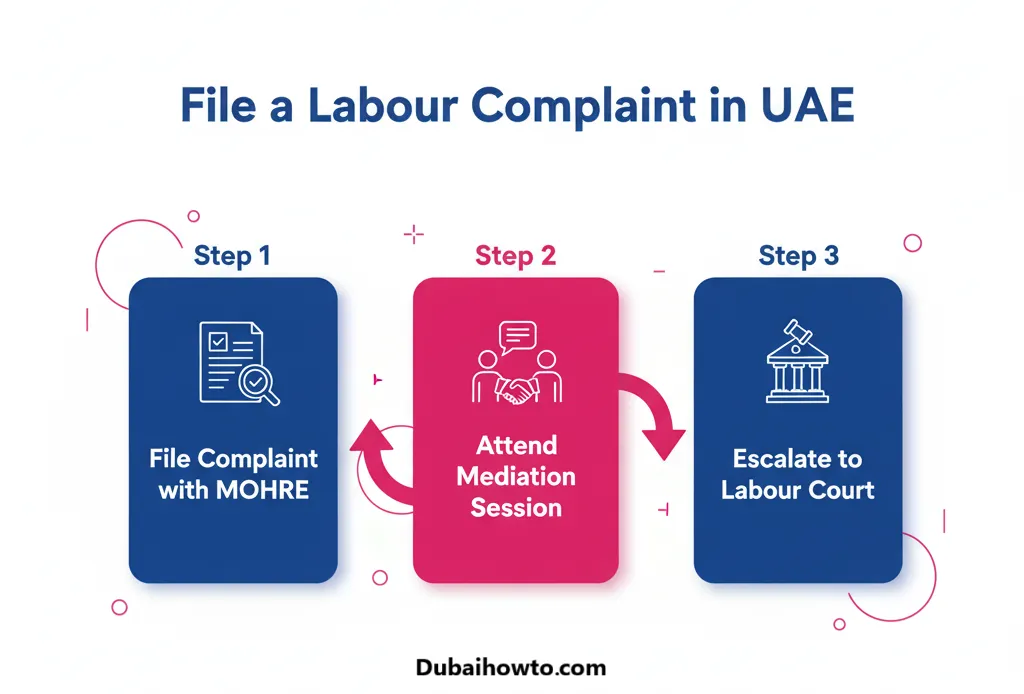
Step 1: Gather Your Documents: Collect your employment contract, termination letter (if any), passport/EID copies, and any evidence (emails, warnings, etc.) related to your dismissal.
Step 2: File a Complaint with MOHRE: You must file a complaint with the Ministry of Human Resources and Emiratisation (MOHRE), typically within 30 days of the dispute. You can do this through the MOHRE app, website, or by calling their hotline (80060).
Step 3: Attend the Mediation: MOHRE will schedule a mediation session (an amicable settlement) between you and your employer. A legal researcher will listen to both sides and try to find a solution based on the law
Step 4: Escalation to Labour Court: If no agreement is reached within 14 days, MOHRE will refer the case to the specialised Labour Court. You will then need to present your case and evidence before a judge.
Pro Tip: Never resign under pressure if you believe your termination is unfair. Signing a resignation letter can severely complicate your ability to file an arbitrary dismissal claim. Always request the termination reason in writing from your employer.
Final Thoughts
While many still use the term Article 120 UAE Labour Law, it’s essential to know your rights under the current law: Article 44 of Federal Decree-Law No. 33 of 2021.
This new article provides a clear, exhaustive list of 12 reasons that justify dismissal without notice. Importantly, the new law protects your end-of-service gratuity, even in cases of summary dismissal. If you feel you have been terminated unfairly, contact MOHRE immediately to understand your options.
Disclaimer: This article is for informational purposes only and does not constitute legal advice. You should consult with a legal professional for advice on your specific situation. Fees and regulations are subject to change.
Frequently Asked Questions (FAQs)
1. What is the main difference between old Article 120 and new Article 44?
The main difference is the law itself. Article 120 was part of the repealed Federal Law No. 8 of 1980. Article 44 is the current, active provision under Federal Decree-Law No. 33 of 2021. The list of reasons is also updated and clarified in Article 44.
2. Can I be fired without a warning in the UAE?
Yes, but only for one of the 12 specific reasons listed in Article 44 (like assault, intoxication, or forging documents). For performance-related issues, the law (Article 44, clause 4) requires a written investigation and two prior written warnings.
3. Do I lose my gratuity if fired under Article 44?
No. Under the new labour law (Article 52), you are entitled to your end-of-service gratuity based on your years of service, even if you are terminated for gross misconduct under Article 44. This is a major change from the old law.
4. How do I prove my termination was unfair?
The burden of proof for summary dismissal is on the employer. If you file an arbitrary dismissal claim, you would present your side (e.g., the termination was for a different reason), and the employer would have to prove they followed the law and had a valid Article 44 reason.
5. What is summary dismissal in UAE labour law?
Summary dismissal is another term for termination without notice. It is an immediate dismissal from employment, which is only legally allowed if the employee commits one of the serious violations outlined in Article 44 of the UAE Labour Law.
Last updated: October 2026
Reviewed by: Legal Review Team

Author: The DubaiHowto Editorial Team
DubaiHowto is an independent informational platform created to help UAE residents and visitors understand everyday services such as public transport, telecom, government procedures, visas, fines, and utility systems.
Our editorial team researches and verifies content using official UAE sources (including government portals, service providers, and regulatory authorities) and real on-ground experience of living in the UAE. Each guide is written to be practical, easy to understand, and regularly updated to reflect the latest rules, fees, and procedures.
We focus on clarity, accuracy, and usefulness — especially for people navigating UAE systems for the first time. Learn More about DubaiHowto.
Last reviewed: February 2026. Sources: Official UAE portals and service providers